8 hr
Kairouan Sacred City & El Jem Amphitheatre Day Tour from Hammamet
Discover Tunisia's spiritual heart and Roman heritage on this full-day guided excursion
Reserve
Hand-picked by our editors — only the best 5 tours from 47 reviewed.
Verified partners for every tour, free cancellation where available, and instant confirmation on every booking.
8 hr
Discover Tunisia's spiritual heart and Roman heritage on this full-day guided excursion
Reserve
9 hr
Discover Tunisia's spiritual heart and Roman legacy on a captivating journey through sacred sites and ancient arenas
Reserve
5 hr
Discover Tunisia's spiritual heart and Roman amphitheater with expert guidance, transport, and midday meal
ReservePrices from verified partners. Availability updates in real time at checkout. Free cancellation policies apply where shown.
The landmarks, rooms, and views travelers on this tour remember — all visible on a single visit.
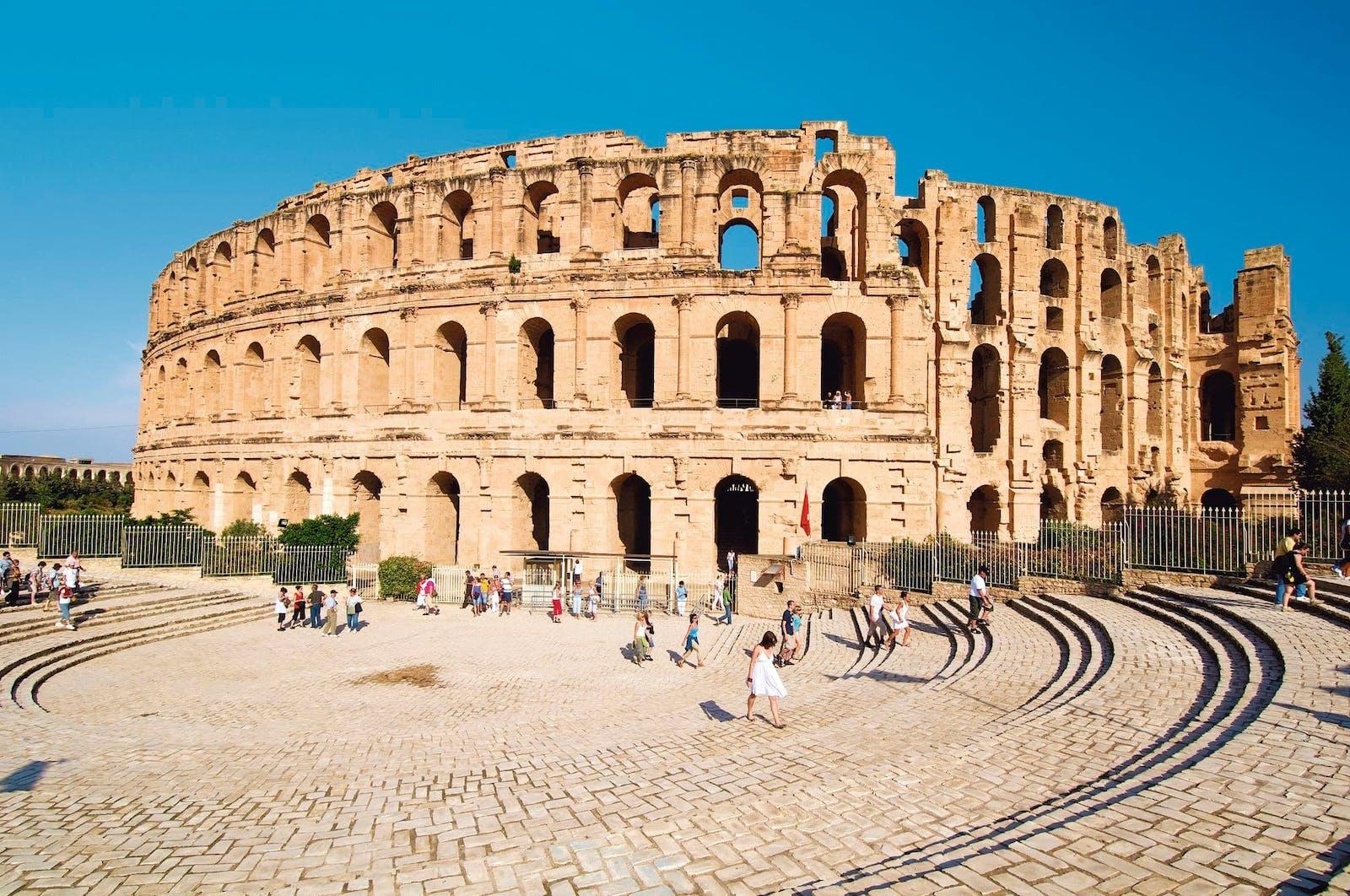
The central fighting area where gladiator contests were once held, offering a view of the towering walls.
The complex underground network where gladiators and animals awaited combat before being raised to the arena.
The steep stone rows that could accommodate up to 35,000 spectators at the peak of the Roman era.
Features a stunning collection of local Roman mosaics and architectonic artifacts from ancient Thysdrus.
Travelers seeking focused antiquity prefer the Kairouan holy city and el jem tour from hammamet, while those desiring regional variety choose the broader coastal circuit. Both experiences offer distinct access to UNESCO heritage sites and Roman architecture.
| Feature | Top pick Historical Focus | Coastal Multi-City Loop |
|---|---|---|
Historical Depth |
High (Focused) | Moderate (Generalist) |
Time at Monuments |
2.5–3 hours | 1–1.5 hours |
Travel Distance |
Lower mileage | Higher mileage |
Cultural Immersion |
Deep dive into religion | Broad regional exposure |
Pace of Day |
Reflective and steady | Fast and active |
| See tickets → |
Verdict: If you prioritize a thorough examination of the Amphitheatre and the Great Mosque, the kairouan holy city and el jem tour from hammamet is superior to the faster kairouan holy city and el jem tour from hammamet tour, which often sacrifices site time for coastal sightseeing. Many travelers booking kairouan holy city and el jem tour from hammamet tickets value the lower travel time and deeper educational context over the wider geographic coverage of coastal loops.
Choose your ticket, select your date, and reserve in under two minutes. Secure checkout handled by our verified partner.
Instant confirmation by email, with a mobile voucher you can save offline. No printing, no queuing at a collection desk.
Arrive at the entrance, show your voucher on your phone, and walk in. Most tickets include priority or skip-the-line access.
Practical details for your visit straight from our verified partners — hours, access, rules, and how to get there.
Modest clothing is recommended when visiting religious sites in Kairouan. Light, breathable fabrics are best for the heat in El Jem.
There are no official locker facilities at the site. It is advisable to travel light or check if your transport provider can secure your belongings.
Photography is permitted throughout the ruins. Capture the impressive subterranean chambers and arena vistas.
The site is historic and features rugged, uneven terrain. Navigating the steep tiers and underground tunnels is physically demanding.
The site is suitable for history-minded children. Supervise minors closely near the steep staircases and elevated stone walkways.
Carry adequate water supplies. There are local restaurants and small cafes near the main site in El Jem.
Best time to go, insider tips, nearby landmarks, and the cancellation fine print — flip through to skim what matters to you.
Flexible, no hidden fees.
Full refunds are typically provided for cancellations made within the operator's specified window, usually 24-48 hours before the tour. Note that the 12 TND entrance fee covers both the Amphitheatre and Archaeological Museum.
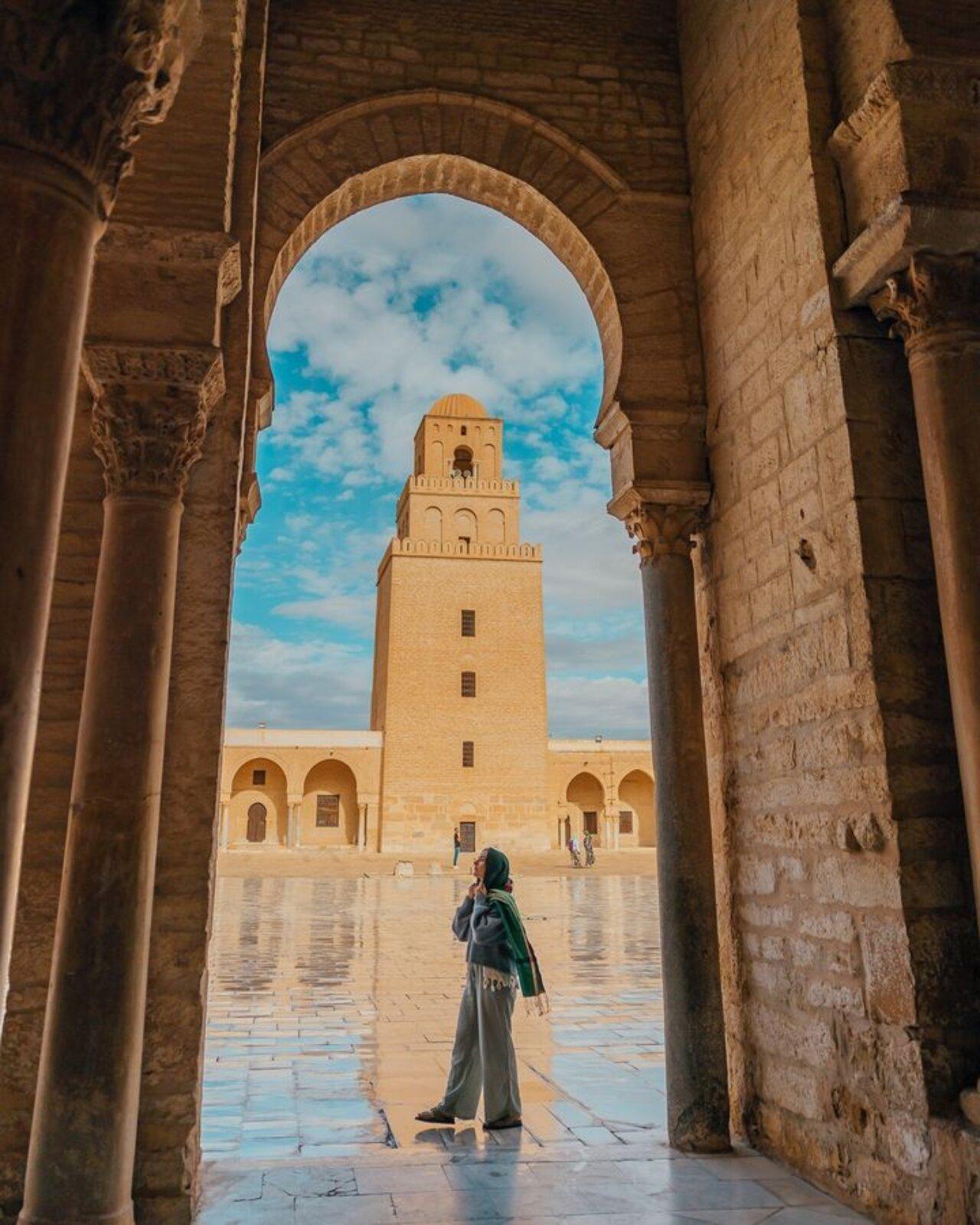
The Great Mosque of Kairouan, built in 670 CE by Uqba ibn Nafi, predates the Dome of the Rock and ranks among Islam's oldest prayer halls still in continuous use. Its forest of 414 antique columns—salvaged from Carthaginian and Byzantine ruins—supports a hypostyle prayer hall that inspired every Maghrebi mosque that followed. Kairouan became North Africa's first Arab capital and the fourth holiest city in Islam, a pilgrimage destination when Mecca lay beyond reach. Seven visits to Kairouan, tradition holds, equal one hajj. Today the medina remains a working spiritual center. Artisans hammer copper in workshops unchanged since the Aghlabid dynasty, and the Zaouia of Sidi Sahab preserves the tomb of a companion of the Prophet. The city's ninth-century Aghlabid Basins, two monumental reservoirs fed by aqueduct, supplied a population of 100,000 in an age when few European cities surpassed 20,000. UNESCO inscribed Kairouan in 1988 for its role as a cultural and religious nexus that shaped the western Islamic world. Seventy kilometers east, the Amphitheatre of El Jem rises from flat Sahel farmland like a stone mirage. Completed around 238 CE under proconsul Gordian, it seated 35,000 spectators—more than the town's current population—and rivals the Colosseum in scale and preservation. Its three-story arcade of Corinthian columns stands nearly intact, the subterranean passages where gladiators and lions waited still navigable. The structure was never finished; Rome's third-century crisis halted construction, leaving toolmarks visible on unpolished blocks. In 1695, defenders used the amphitheatre as a fortress during the Kahina Revolt; Ottoman cannon fire breached the western wall, the only major damage in 1,800 years. El Jem's Archaeological Museum, housed in a French colonial villa adjacent to the amphitheatre, displays mosaics excavated from nearby Roman villas: hunting scenes, mythological panels, geometric patterns in tesserae so fine they approach painting. One mosaic depicts a procession of musicians and dancers celebrating Dionysus, the god's panther rendered in stone chips smaller than lentils. The museum's collection illustrates the wealth of Thysdrus, an olive-oil exporting city whose prosperity funded the amphitheatre and whose decline left it standing, too remote to quarry.
"Seven visits to Kairouan equal one hajj, when Mecca lay beyond reach."
A step-by-step walkthrough of the visit — what you'll see, how long each stage takes, and the details that matter.
You depart Hammamet at first light, the coast road threading through olive groves that supplied Roman Thysdrus. Your first stop is El Jem, where the amphitheatre's ochre limestone facade dominates the skyline before you enter the town. You walk through the main gate as gladiators did, emerging onto the arena floor where sand once soaked blood. The scale registers slowly—35,000 seats rising in three tiers, the upper arcade open to sky. You descend into the hypogeum, the underground warren of cages and winch rooms, touching grooves worn into stone by ropes that hoisted wild animals. After the Archaeological Museum's mosaics, you drive inland to Kairouan. The medina announces itself with the Great Mosque's square minaret, a beacon visible for kilometers. You remove your shoes at the entrance; non-Muslims view the courtyard and prayer hall from the threshold. Afternoon light slants through horseshoe arches onto columns of porphyry and marble, each one plundered from a different ruin. The mihrab's lusterware tiles, imported from Baghdad in the ninth century, still gleam. You walk the medina's alleys to the Aghlabid Basins, their stone embankments enclosing still water where swallows dip. If lunch is included, you pause for couscous and grilled merguez before visiting the Zaouia of Sidi Sahab, its courtyard tiled in geometric zellige. You return to Hammamet by evening, the route retracing 1,300 years in a single day.
The Amphitheatre is open daily from 08:00–17:30.
Yes, your 12 TND entry fee grants access to both the Amphitheatre and the Archaeological Museum.
We recommend an arrival between 08:00–10:00 to avoid peak heat and large crowds.
While the Amphitheatre is relaxed, modest dress is required for visiting mosques in Kairouan.
The tour is appropriate for families, though children should be supervised around the historic, uneven ruins.
Tickets are typically managed by your tour operator, but site access is straightforward with the 12 TND fee.
Bring sunscreen, sunglasses, a hat, and sturdy walking shoes for the rocky paths.
Prohibited items include drones, large backpacks, and professional camera equipment.
Your tour from Hammamet will typically include organized private or group transport.